
By Badir McCleary
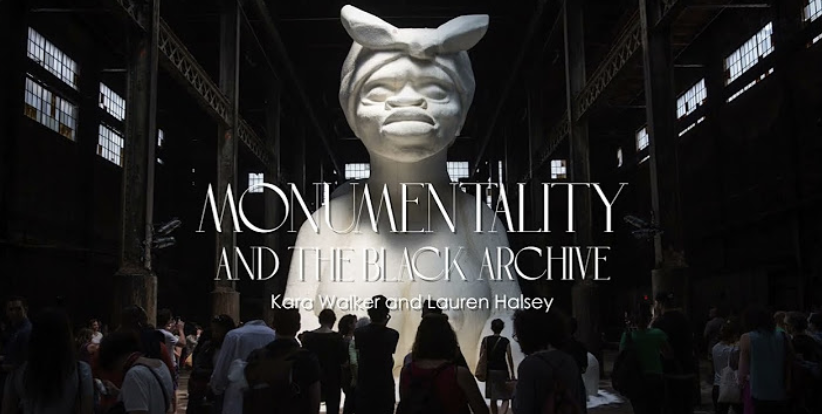
When we look at the work of Kara Walker and Lauren Halsey, we’re not just looking at sculpture—we’re looking at two fundamentally different ways of building Black history into space. And one of the most important things to pay attention to—before anything else—is location. Walker’s ‘A Subtlety’ was installed inside the Domino Sugar Refinery, in the Williamsburg neighborhood of Brooklyn, NY. An abandoned industrial site—once part of a system directly tied to sugar production and enslaved labor. That context isn’t secondary to the work. It is the work.
Halsey’s ‘Sister Dreamer’, on the other hand, sits at 78th and Western in Los Angeles—her neighborhood. South Central. Not removed. Not reframed through distance. But built directly within the environment that informs it. That difference matters. Because in Walker’s installation, she is placing the viewer inside a historical system—one rooted in extraction, labor, and consumption. Even the material—sugar—is not symbolic. It’s literal. It carries the full weight of that history. Halsey moves a bit differently.
Her work builds from within. Through Sister Dreamer and the larger Crenshaw District Hieroglyph Project, she constructs a space that archives Black cultural life—through signage, symbols, language, and memory. It’s not about placing history on display. It’s about preserving it in place. And experiencing that in person shifts everything.
I had an immediate sense of appreciation seeing Sister Dreamer finally completed and installed in the streets. I’ve followed this work across multiple stages—through exhibitions, installations, and iterations—from Los Angeles to the Venice Biennale. But seeing it here, in its home, although temporarily, is something entirely different. It’s not just a work of public art anymore—it’s part of the environment.
I never had the opportunity to see Walker’s A Subtlety in person. But I’ve spent time with the images, the documentation, the responses. And even through that distance, the scale and presence come through clearly. It’s an artwork that stays with you. Both of these works are monumental. Both reference sphinx-like structures—forms historically tied to power, mythology, and permanence. And both carry meaning that often runs deeper than what the average viewer initially recognizes.
But they operate in fundamentally different ways. Walker’s work exposes. It reveals the conditions of history—unfiltered. It places the Black body within systems that consumed it, commodified it, and displayed it. Even the audience interaction became part of that dynamic. Halsey’s work protects. It builds an environment where Black culture is not extracted—but preserved, layered, and made monumental on its own terms. And that leads to a critical distinction: Walker’s work is tied to disappearance. The sugar dissolves. The installation was temporary. The site itself was on the verge of erasure.
Halsey’s work builds toward permanence. Even though Sister Dreamer is currently on view for a limited time, there is a clear desire—from the community, and from myself—for it to remain. For it to stay embedded in the space it belongs to. Because where Walker reveals what was taken, Halsey protects what remains. One constructs a monument as a warning. The other constructs a monument as an offering. And together, they don’t contradict each other. They map the full condition of Black life—across history, across space, and across time.